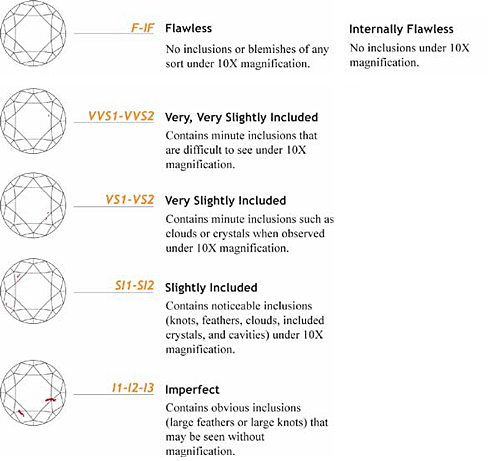
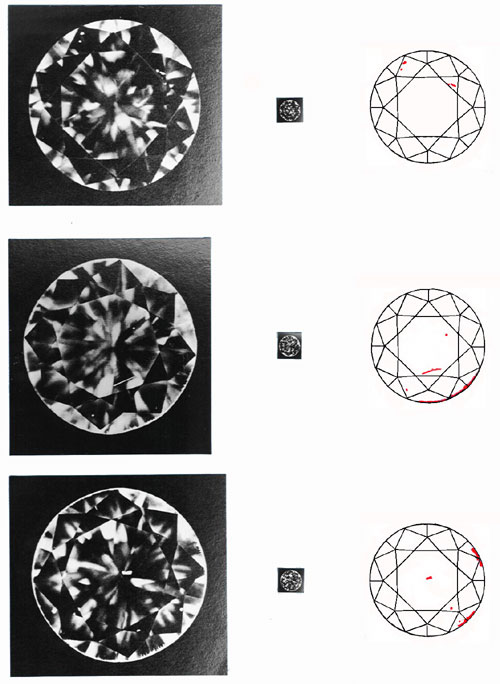
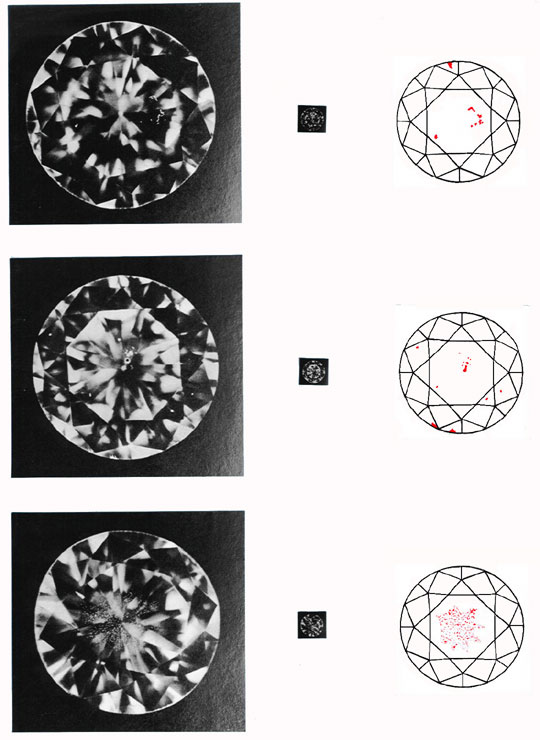
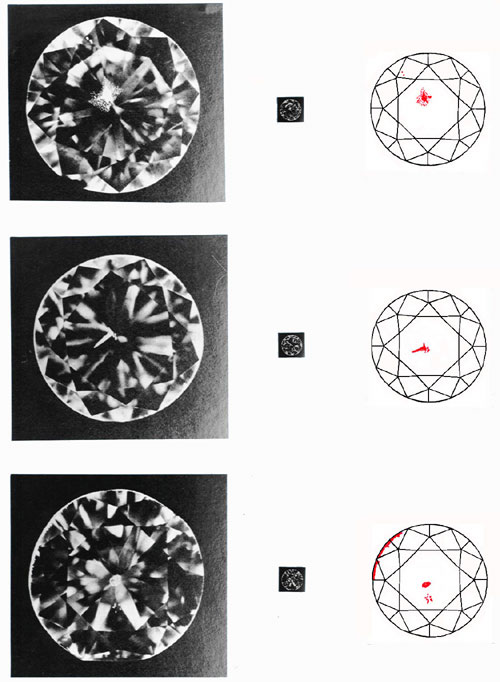
GIA CLARITY GRADING SCALE
Diamonds that are free of inclusions are more rare and more valuable than stones with inclusions.
1. Clarity in a diamond refers to the presence or absence of imperfections on or in the stone. The closer a diamond is to being free from blemishes or inclusions the more rare and valuable it is.
2. Diamond clarity ranges from what we define as flawless to imperfect. The GIA clarity grading scale ranges from Flawless (FL) and Internally Flawless (IF) through Very Very Slightly included (VVS1 and VVS2), Very Slightly included (VS1 and VS2), Slightly Included (SI1 and SI2) and Imperfect (I1, I2 and I3).
3. All clarity grades from FL to SI2 will appear eye clean to an expert grader without magnification when viewed from the top.
4. To the average consumer many imperfect diamonds, especially those graded "I1" will appear to be free of flaws without magnification.
5. Although two diamonds may both appear as eyeclean without magnification, their actual clarity grades may be far apart. This difference in clarity grades may result in a difference in value of hundreds or even thousands of dollars.
6. Even with the benefit of magnification, most consumers do not have enough clarity grading knowledge or experience to accurately determine the clarity of a diamond that they are viewing.
DIAMOND CLARITY AND ITS EFFECT ON VALUE
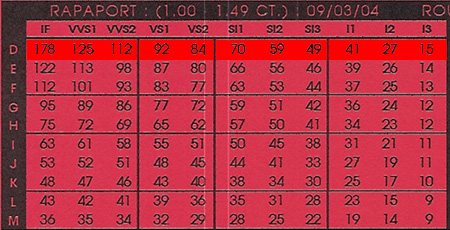
There are several diamond price sheets that appraisers throughout the nation consult to estimate the wholesale value for diamonds. The Rapaport Diamond Report is likely the most widely used.
1. A well cut and strictly graded 1 ct "Internally Flawless" and "D" color diamond would wholesale for about $18,100- per ct.
2. A well cut and strictly graded 1 ct "SI2" and "D" color diamond would wholesale for about $5,900- per ct.
3. The price difference of $12,200 per carat is based entirely on the 6 grade difference in the clarity of the two stones.
DIAMOND CLARITY CHARACTERISTICS
BLEMISHES (external characteristics)
1. Abrasions: tiny nicks on facet junctions or the culet; caused by wear or by contact with other diamonds.
2. Extra Facets: small facets placed to remove imperfections; not part of the cutting style. (Not to be confused with Added Facets which are added symmetrically and are part of the cutting style.)
3. Naturals: part of the original crystal surface remaining on the polished stone, frequently in the area of the girdle.
4. Polish Lines and Marks: tiny parallel lines or surface clouding left by irregular polishing or excessive heating during polishing, respectively.
5. Rough Girdle: a grainy or pitted girdle surface usually caused by poor workmanship.
6. Surface Graining: structural irregularities in crystal growth; may appear as faint lines, causing grooved or wavy surfaces that often cross facet junctions.
INCLUSIONS (internal characteristics)
1. Bearding: tiny feathers extending inward from a bruted girdle surface. (Bruting is the process of rubbing two diamonds together to achieve the rounded shape of the diamond.)
2. Cavities and Chips: large/deep openings, and small/shallow openings in the diamond's surface, respectively.
3. Clouds: hazy or milky areas of many very small, usually crystalline inclusions.
4. Feathers: cleavages or fractures that are often white and feathery in appearance. There are 4 cleavage planes in diamond, which run in octahedral directions. Fractures are breaks along planes other than cleavage planes and may alternate with them to form step-like feathers.
5. Included Crystals: mineral crystals, such as garnet or peridot, contained inside a diamond.
6. Indented Naturals: natural rough surfaces that penetrate the stone and may distort the girdle outline.
7. Internal Graining: regions of irregular crystal growth that may appear as milky or colored lines or streaks, or they may be reflective.
8. Laser Drill Holes: a tiny tube made by a laser; the surface opening may resemble a pit, while the tube usually resembles a needle.
9. Needles: needle-shaped included crystals.
10. Pinpoints: areas of minute, dot-like inclusions.
11. Twinning Wisps: cloudy areas produced by distorted crystal growth.
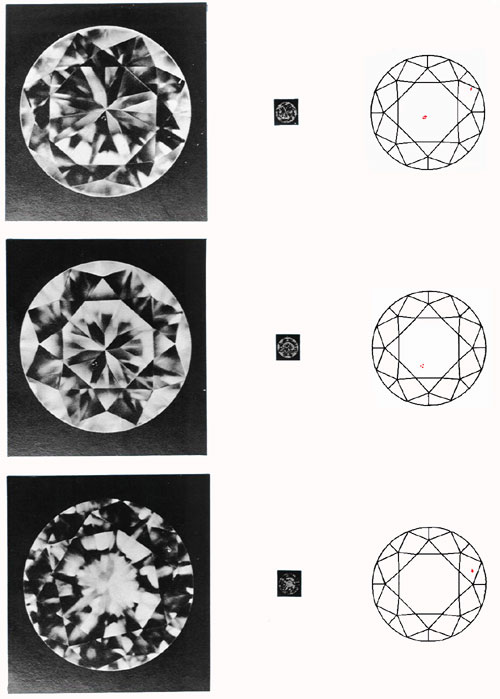
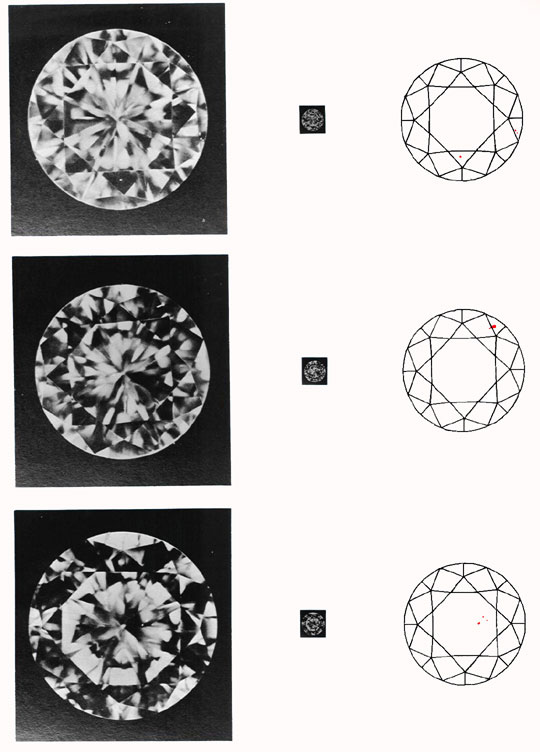
EXAMPLES
Clarity: VS1